
Law of Sines Calculator
The law of sines links each side of a triangle to the sine of its opposite angle: a/sin A = b/sin B = c/sin C. This calculator uses it to solve a triangle from two angles and a side (AAS or ASA), or two sides and an angle opposite one of them (SSA) — where there can be no triangle, one, or two. It shows every step, the area and perimeter, and draws each solution to scale.
- Free to use
- No sign-up
- Runs in your browser
Law of sines solver
Law of Sines and Cosines Worksheets
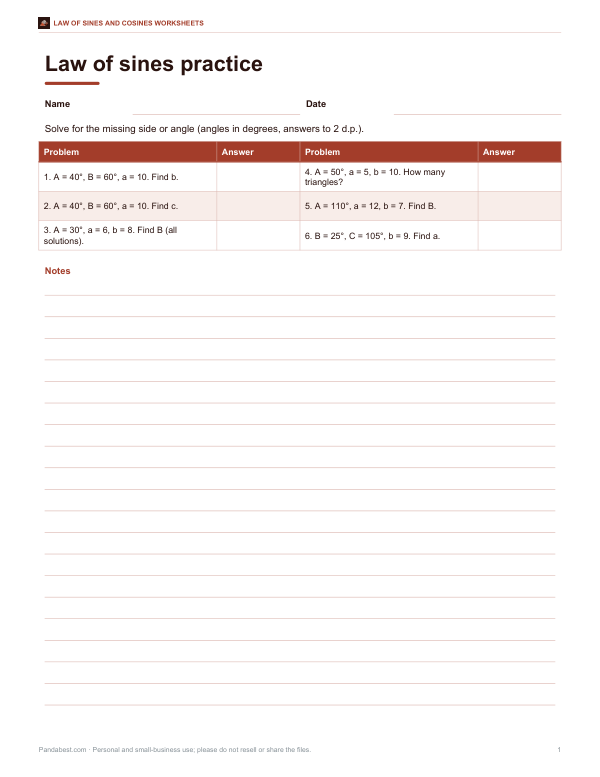
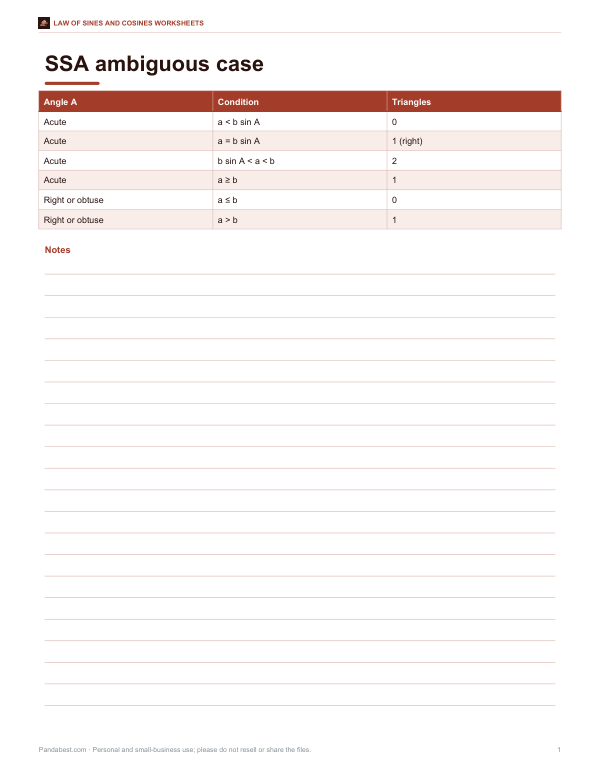
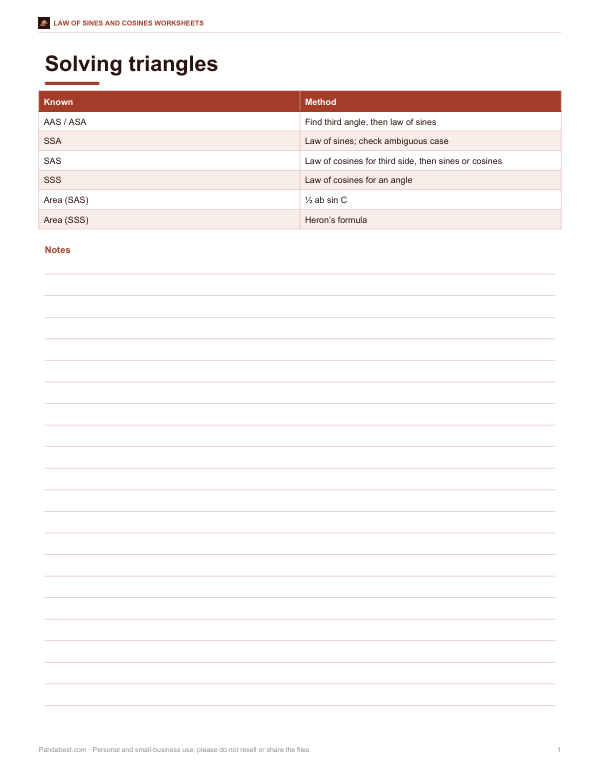
Law of sines and law of cosines practice sheets with worked answers, an ambiguous-case decision chart and a triangle-solving reference card.
- Law of sines (PDF, DOCX)
- Decision chart (PDF)
- Reference card (PDF)
Formats: PDF, DOCX. Instant download after payment (link valid 72 hours, up to 5 downloads). AI-assisted: the templates were drafted with AI help and reviewed and laid out before publishing.
$3.00 USD, one-time 3 files · about $1.00 each
- Instant download
- 7-day refund
- Secure checkout by Stripe
7-day money-back guarantee. Full refund within 7 days of purchase, even after you download.
Full refund within 7 days — see the refund policy and license.
Free printables
Single sheets you can print right now, no sign-up. The full pack adds every sheet in one download plus the editable files.
The law of sines
In any triangle with sides a, b, c opposite angles A, B, C: a / sin A = b / sin B = c / sin C. Each ratio also equals the diameter of the triangle’s circumscribed circle (2R). Use it when you know an angle and its opposite side plus one more piece of information — two angles and a side (AAS or ASA) or two sides and an angle opposite one of them (SSA). For two sides and the included angle (SAS) or three sides (SSS), use the law of cosines instead.
Which rule to use
| You know | Case | Use |
|---|---|---|
| Two angles and any side | AAS / ASA | Law of sines — always one triangle |
| Two sides and an angle opposite one of them | SSA | Law of sines — 0, 1 or 2 triangles |
| Two sides and the angle between them | SAS | Law of cosines |
| Three sides | SSS | Law of cosines |
| Three angles | AAA | No unique triangle (only the shape) |
The ambiguous case (SSA)
| Condition (angle A acute) | Number of triangles |
|---|---|
| a < b sin A (a shorter than the height) | None |
| a = b sin A | One (a right triangle) |
| b sin A < a < b | Two |
| a ≥ b | One |
If angle A is obtuse or right, there is one triangle when a > b and none otherwise. The calculator checks all of this automatically and shows both triangles when two exist.
Worked example: two triangles
Given A = 35°, a = 7 and b = 10: sin B = 10 × sin 35° ÷ 7 ≈ 0.8194, so B ≈ 55.02° or B ≈ 180° − 55.02° = 124.98°. Both work because each leaves room for a positive angle C. Solution 1: C ≈ 89.98°, c ≈ 12.20. Solution 2: C ≈ 20.02°, c ≈ 4.18. The drawings show a “swinging” side a that can meet the base line in two places.
Worked example: AAS
Given A = 40°, B = 60° and a = 10: C = 180° − 40° − 60° = 80°. The ratio a / sin A = 10 / 0.6428 ≈ 15.557, so b = 15.557 × sin 60° ≈ 13.47 and c = 15.557 × sin 80° ≈ 15.32. The area is ½ × b × c × sin A ≈ 66.3 square units.
Common mistakes
- Mixing degree and radian mode on a calculator — check the setting.
- Using the law of sines for SAS or SSS, where no angle–opposite-side pair is known.
- Forgetting the second solution in SSA problems.
- Rounding too early — keep full precision until the final answer.
- Pairing a side with the wrong angle; each side must be opposite its angle.
Why the law of sines works
Drop a perpendicular from vertex C to side c, with height h. In the right triangle on one side, h = b sin A; in the other, h = a sin B. So b sin A = a sin B, which rearranges to a / sin A = b / sin B. Doing the same from another vertex brings in c / sin C. The common value equals 2R, the diameter of the circle through all three vertices — a neat link between trigonometry and circle geometry.
Law of cosines, briefly
| Formula | Use |
|---|---|
| c² = a² + b² − 2ab cos C | Find a side from two sides and the angle between them (SAS) |
| cos C = (a² + b² − c²) / (2ab) | Find an angle from three sides (SSS) |
When C is 90°, cos C = 0 and the law of cosines becomes Pythagoras’ theorem. After finding one angle with the law of cosines, the law of sines is often the quickest way to finish the triangle — but use cosines for the largest angle to avoid ambiguity.
Checking your answers
- The three angles must add up to 180° (π radians).
- The longest side is opposite the largest angle; the shortest opposite the smallest.
- Each side must be less than the sum of the other two.
- Substitute back: a / sin A, b / sin B and c / sin C should all be equal.
Where it’s used
- Surveying and navigation: finding distances to points you can’t reach, from angles measured at two places (triangulation).
- Astronomy: estimating distances using angles.
- Engineering and construction: forces and geometry in trusses.
- Physics: resolving vectors when angles are known.
Trigonometry worksheets
The optional pack includes law of sines and law of cosines practice sheets with worked answers, an ambiguous-case decision chart and a triangle-solving reference card. The calculator above is free.
AI-assisted content
This page was drafted with AI assistance and reviewed before publishing.
Frequently asked questions
What is the law of sines?
a / sin A = b / sin B = c / sin C for any triangle.
When do you use the law of sines?
When you know an angle and its opposite side plus another angle or side (AAS, ASA, SSA).
What is the ambiguous case?
In SSA, the given information can fit zero, one or two different triangles.
How do I know if there are two triangles?
For acute A, two triangles exist when b sin A < a < b.
When should I use the law of cosines instead?
For SAS or SSS problems.
Does it work in radians?
Yes, switch the angle unit.
Can the law of sines find an obtuse angle?
Yes, but sin⁻¹ only returns acute angles, so check whether 180° minus that angle is also possible — that is the ambiguous case.
What is 2R in the law of sines?
The diameter of the triangle’s circumscribed circle; each ratio a / sin A equals it.
How do I find the area once the triangle is solved?
Use ½ × two sides × sine of the angle between them, e.g. ½ bc sin A.